Easter Inadequacy
Labels: Sermon Planning, Spiritual Life
Personal Productivity for Pastors
Labels: Sermon Planning, Spiritual Life
Labels: Processes, Sermon Planning, Spiritual Life, Tips n Tricks
Labels: Balance, Leadership, Meetings, NCD, Priorities, Reading, Sermon Planning
Labels: Processes, Sermon Planning, Software, Tips n Tricks
Labels: Balance, Processes, Sermon Planning
A couple weeks ago in The Amazing Expanding Project, I wrote about short-scheduling your projects as a great way to manage time and beat procrastination. Unfortunately, the example I used was preaching. And upon further reflection, I have decided that I didn't really need to encourage pastors to spend less time on their sermons (in general).Labels: Accountability, Balance, Leadership, Priorities, Processes, Procrastination, Sermon Planning
Brian Mavis, former pastor and general manager of the pastoral resource Web site SermonCentral.com, suggests that pastors combine an expository and topical method to be both biblical and relevant. He describes the style as “topositional” preaching.I think this middle road is more difficult. It means you have to understand what the needs are in your congregation and community. And you have to know your Bible well enough to see larger biblical principles faithfully in context. It means you must be connected and disciplined.
Labels: Balance, Sermon Planning
Labels: Balance, GTD, Lifehacks, Personal Life, Priorities, Procrastination, Sermon Planning, Time Management, Tips n Tricks
Labels: Processes, Sermon Planning, Spiritual Life, Tips n Tricks
Ever since the beginning of my ministry, I have used PowerPoint for my sermons. There. That shows you how old I am.This is basically how I use PowerPoint for my sermons (Although I don't necessarily keep it to only 3 bullet points, depending on what the text is trying to say...).
Illustration for Main Point
Text 3:16
Bullet Point (principle from the text)
And then for each bullet point, I state the principle, show where I found it in the text, explain it or illustrate it, and then apply it to real life. Then I go to the next bullet point.
This is a great way to make sure the sermons are biblical, sound, focused, and relevant.
I also publish a sermon handout (fill-in-the-blanks) sheet in the bulletin every week to make it easy for people to follow along and have something to "take away" from the service.
Here are some links to show you how this looks in my last week's sermon:PPT
Outline
Blanks
mp3
(Feel free to use any other sermon material you find on my site. That's why it's there.)
BTW, I haven't always done my PowerPoint this way. When I originally started, I used to spend hours and hours finding just the right pictures or putting all of my Bible texts on the slides. Back then, I spent more time on the look than the content. Don't fall into that trap.
Labels: Processes, Sermon Planning, Tips n Tricks
Time Management:
Personal Vision Workbook (now a book):
Sermon Planning:
Labels: GTD, Personal Vision Workbook, Processes, Sermon Planning, Time Management, Tips n Tricks, Values, Vision
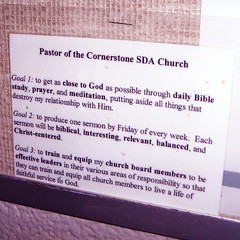
In Kenneth Blanchard's classic One Minute Manager, he talks about having One Minute Goals so you (and your supervisor) know what you're about (and not about). Something that you have prominently displayed so that you can review it in about One Minute every day.Goal 1: to get as close to God as possible through daily Bible study, prayer, and meditation, putting aside all things that destroy my relationship with Him.
Goal 2: to produce one sermon by Friday of every week. Each sermon will be biblical, interesting, relevant, balanced, and Christ-centered.
Goal 3: to train and equip my church board members to be effective leaders in their various areas of responsibility so that they can train and equip all church members to live a life of faithful service to God.
This has really helped me to remember the essentials. It's what I'm paid to do. Everything else the church gets out of me is a bonus.
Labels: Balance, Priorities, Processes, Sermon Planning, Time Management, Tips n Tricks, Values
Labels: GTD, Sermon Planning, Time Management, Tips n Tricks
Labels: GTD, Personal Vision Workbook, Processes, Sermon Planning, Software, Tips n Tricks
Labels: GTD, Processes, Procrastination, Sermon Planning, Time Management, Tips n Tricks
Labels: Family, Lifehacks, Procrastination, Sermon Planning, Time Management, Tips n Tricks
Labels: Processes, Retreat, Sermon Planning, Tips n Tricks
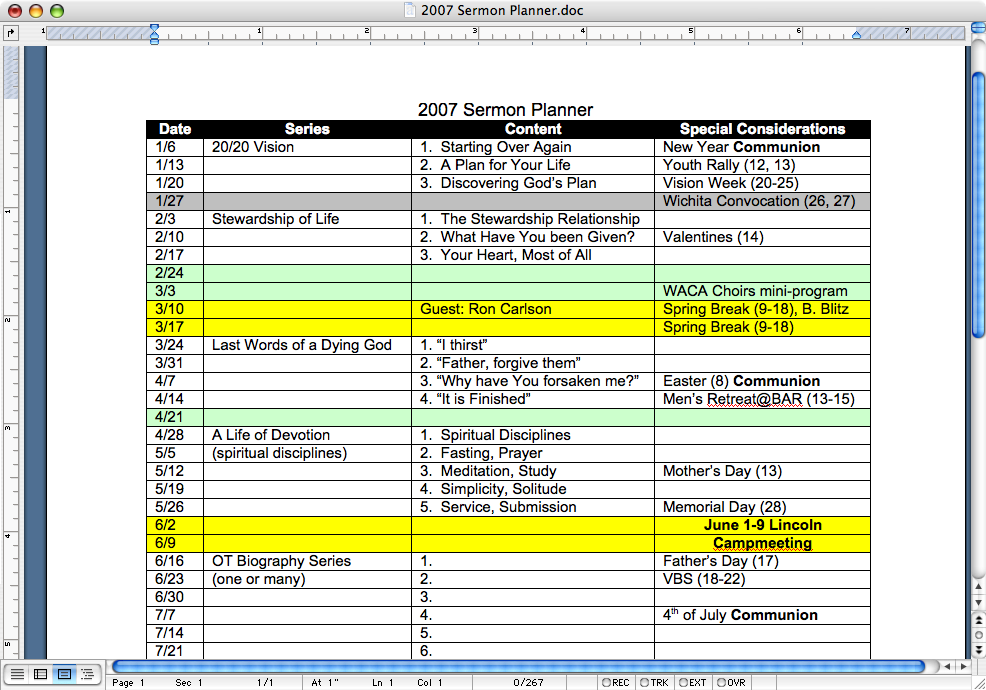
Planning out my sermonic year seemed like such a good idea. So I would put it on my list: "Plan Sermonic Year." And I would look at those words every day. And the guilt would build. I knew I needed to do it, but I didn't know where to start. Every year, I would take a couple of months and reinvent the wheel. No more! Now I have a written process that I use as a checklist.In October, I start working on the master calendar for the next year. I include holidays, conferences, special events, vacation, communions, etc. on a master calendar. Then I use a one-page calendar (formatted in MSWord) for the sermon planning, so I can see the whole year at a glance.
There are certain topics I do every year - Vision in January; Life/Teachings of Christ around Easter; Values/Mission of the church in the Summer; Marriage/Parenting after Labor Day. I plan 3-4 other major topics (spiritual disciplines, OT Bible characters, denominational distinctives, book of the Bible, Christian basics, prophecy, stewardship, etc).
I collect sermon series ideas wherever I find them all year long. I plan series 3 to 6 weeks long (I get bored with my own series if they're much longer). I use a sermon series planning worksheet and put it in my sermon planning workbook. In November, I take a look at what I've collected all year long from books, devotionals, church needs, current events and culture (we'll address sermon series planning more later).
I try to put 1-3 weeks of space between series. That way, I can address current events and issues, bring in a guest speaker, or take the series a bit longer if the Spirit moves. The completed calendar is a beautiful thing.
In December, I start to invite guest speakers. I invite certain speakers every year - my conference president, for instance. I try to prioritize my speakers and give the important ones all of the available dates before I fill in the rest.6. Give the completed calendar to team members
I give it to the board members, church secretary, musicians, graphic designer, outreach coordinator, etc. - anyone who needs to know.
Labels: Processes, Sermon Planning, Tips n Tricks
God plans ahead (Jer 29:11). And God expects us to plan ahead (Prov 13:16; 16:9). The pastor is a leader. Therefore, the pastor needs to be out ahead of the flock, planning and setting direction.
There is something about planning that the Holy Spirit uses to make my sermons suck less (Prov 16:9). When I've planned ahead, I can give advance information to my music, drama, and planning teams to make each week more cohesive and excellent.
I think of myself as a spiritual dietitian - feeding my congregation. I need to make sure the congregation is getting a balanced diet of theology and practical Christianity, Old Testament and New Testament, denominational distinctives and basics. If I don't plan ahead, I tend to fall back on my pet ideas and favorite topics. The whole Bible is inspired and useful... (2 Tim 3:16; cf. Acts 20:27)
If I don't plan my sermons in advance, I find myself freaking out half-way through the week trying to come up with a scripture. When I do plan ahead, I have a sense of peace knowing that I have a plan for where I'm going (and how I'll get there).
When I've planned my sermons in advance, the Holy Spirit seems to drop sermon illustrations into my lap. I'll be listening to a news story, and I'll think, "that would make a great illustration for my sermon on [blank] in three months." I'll write down the story and note it on my sermon series planning worksheet.So much for why to plan a sermonic year. Next time, I'll write about how to plan a sermonic year.
Labels: Balance, Processes, Sermon Planning, Tips n Tricks